Key takeaways
- Cypionate and enanthate have half-lives around 7-10 days, so at steady state each injection is a small contribution to a large accumulated pool.
- Steady state takes roughly six weeks, which is why how you feel in week two is not what the protocol will eventually deliver.
- Injection frequency is the variable that actually shapes the curve, because it governs the peak-to-trough swing.
- Route and technique matter more than the clock; subcutaneous absorption is somewhat flatter and easier to keep consistent.
- The timing that genuinely counts is the blood draw — at trough, immediately before the next injection, every time.
This question gets asked more than almost any other in the first month of treatment, usually with the assumption that there is a right answer being withheld. There is an answer, and it is duller than the forums suggest: for the long-acting esters used in standard testosterone therapy, the hour you inject does not meaningfully change how you feel or what your labs say. What does change both is the schedule you keep, the route you use, and when you draw the blood. Understanding why the clock drops out is more useful than memorising a rule, because the same reasoning tells you which situations are the genuine exceptions.
Why the clock drops out: the arithmetic of steady state
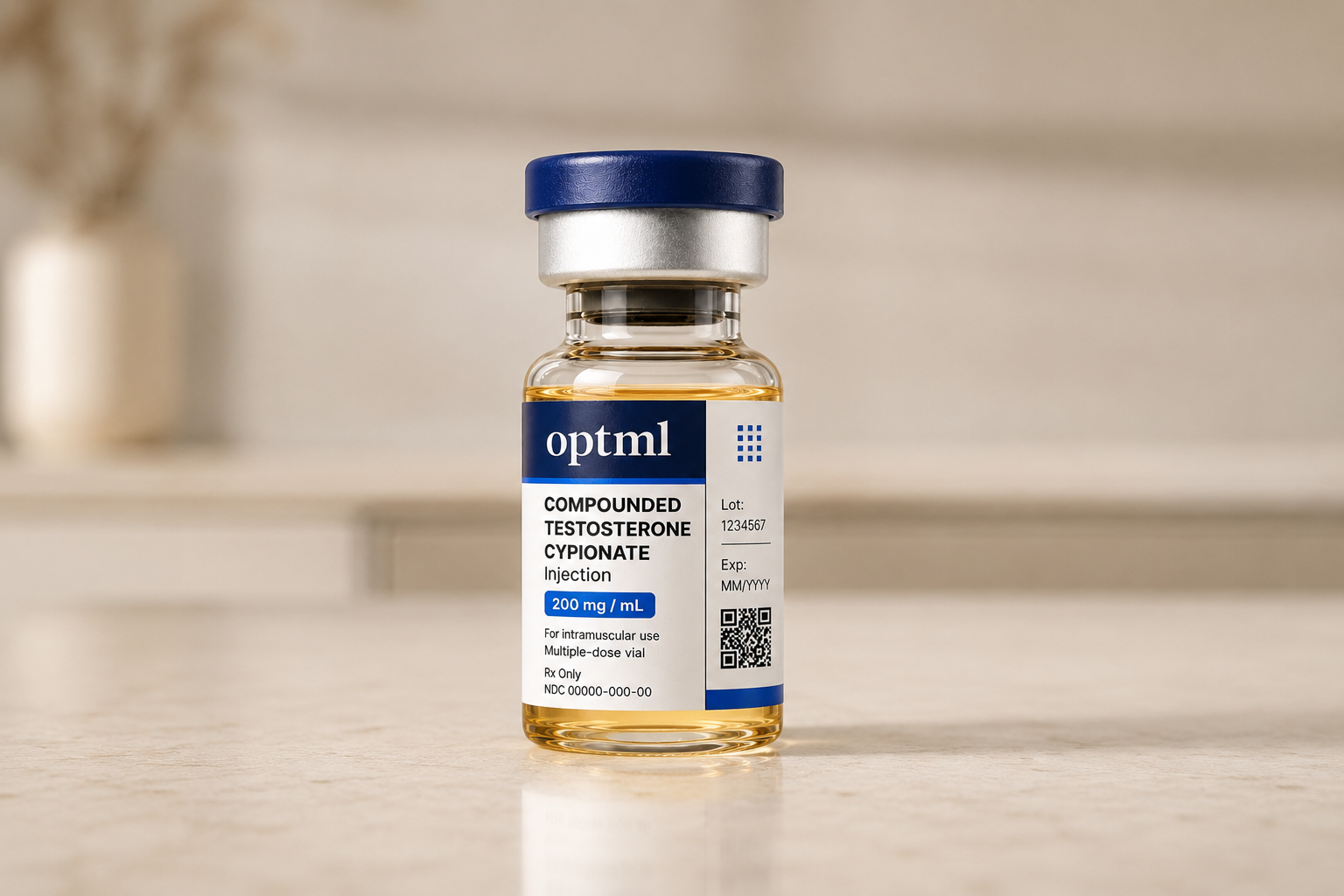
Testosterone cypionate and enanthate are esterified. The ester slows release from the injection depot, and the drug is only active once it has been cleaved off. Both have half-lives in the region of 7-10 days (Partsch et al., Eur J Endocrinol 1995).
That number does most of the work here. A long half-life means each dose is still substantially present when the next one arrives, so drug accumulates until the amount cleared per week equals the amount injected per week. That equilibrium — steady state — takes roughly six weeks of consistent dosing to establish, and once it is established, the level in your blood on any given day is mostly the residue of the previous several weeks, not the shot you took this morning.
Shift that shot by twelve hours and you have shifted a small fraction of a large accumulated pool by half a day. It is not detectable in how you feel and it is not detectable on a panel. This is also why the first six weeks feel unrepresentative: you are still filling the pool, and how you feel in week two is not what the protocol will eventually deliver. The first thirty days covers that ramp in more detail.
The picture would be different with a short-acting ester such as propionate, where each injection genuinely dominates the level for a day or two. Standard therapy does not use those, which is precisely why the timing question dissolves.
The variable that does change the curve
Frequency is the big one, and the reason is the same arithmetic in reverse. Halving the interval roughly halves the distance between peak and trough, because each dose is smaller relative to the accumulated pool.
Moving from every two weeks to once weekly is a large, obvious improvement in smoothness — a great many men who "felt good for a week and then crashed" were describing a fortnightly schedule rather than a dose problem. Moving from once weekly to twice weekly is a smaller but still real gain, and it tends to matter most for men who are sensitive to the trough or who run into oestradiol swings at the peak. Going from twice weekly to daily is a marginal refinement that most men do not need and will not reliably maintain.
Note what this means for troubleshooting. If you feel flat by day six, the question is almost never what time you injected on day one. It is whether the interval is too long for you.
Route and technique
Route. Subcutaneous and intramuscular both work. Subcutaneous absorption is somewhat slower and flatter, and it is easier to self-administer consistently — which in practice matters more than the pharmacokinetic difference itself (Wilson et al., Am J Health Syst Pharm 2018). The comparison is worked through in subcutaneous vs intramuscular.
Technique. Site rotation, an appropriate needle length for the route, and actually drawing the full dose. Repeated injection into the same site produces fibrosis and erratic absorption, and too short a needle on an intramuscular attempt delivers the dose somewhere it was not meant to go — both of which introduce more variability than any timing decision could. Injection technique is worth reading once and then not thinking about again.
| Variable | Effect on outcomes |
|---|---|
| Time of day | None detectable on standard esters |
| Injection frequency | Large — governs peak-to-trough swing |
| Route (subQ vs IM) | Modest — subQ absorption is somewhat flatter |
| Same day each week | Large — this is what makes trough levels interpretable |
| Timing of the blood draw | Large — it determines what the number means |
The timing question that does matter
The clock is irrelevant for the injection and decisive for the blood draw, which is the part most people have backwards.
Two separate ideas get conflated. In men not on therapy, testosterone follows a diurnal rhythm — highest in the morning, lower later in the day, with the rhythm flattening somewhat with age (Diver et al., Clin Endocrinol). That is why diagnostic testing is done in the morning, and guidelines are explicit about confirming a low reading on a repeat morning sample before treating (Bhasin et al., J Clin Endocrinol Metab 2018).
Once you are on therapy, the exogenous dose has replaced that rhythm, and the relevant question is where in the injection cycle you are drawing. A trough draw — immediately before the next scheduled injection — is the reproducible one, because it is the same point in the cycle every time. Draw two days after a shot on one occasion and six days after on the next and you will produce two numbers that appear to disagree while nothing has actually changed. Keep the draw at trough and record the interval on the requisition. The same applies to haematocrit and oestradiol, which is why haematocrit monitoring is only interpretable against a consistent schedule.
The genuine exceptions
Timing recovers some relevance in a few narrow situations.
- Daily subcutaneous protocols. When the interval is a day rather than a week, the injection is a larger share of that day's level. Morning dosing is the convention, on the reasoning that it approximates the natural rhythm. The evidence that this feels better is thin, but it costs nothing.
- Oral testosterone undecanoate formulations. These depend on dietary fat for lymphatic absorption, so they are taken with food. That is a meal-timing requirement, not a circadian one.
- hCG alongside therapy. What matters is spacing across the week rather than hour of day.
- Shift work. If your sleep-wake cycle is inverted, "morning" is a meaningless instruction. Anchor to your own wake time.
The clinical pearl: adherence beats optimisation. The schedule you will still be running in five years outperforms the theoretically perfect one you abandon in two months. Pick a day, tie it to something you already do reliably, and spend the attention you were going to spend on timing on dose accuracy, injection technique, and drawing labs at a consistent point in the cycle.
Building a schedule you will actually keep
The practical version is short.
- Choose a day and time that attaches to an existing routine — Sunday evening, Saturday morning, whatever recurs without effort.
- Use the same day every week. Consistency is what makes a trough level mean something.
- If you split to twice weekly, space the doses evenly — Monday and Thursday, not Friday and Saturday.
- If you miss one, take it when you remember and return to the normal slot next time. Do not double up.
- Book lab draws immediately before an injection, and note how long it has been since the last one.
Where dose and frequency should actually sit for you is a clinical decision made after evaluation and repeat labs, not a number to copy from a forum. The full treatment guide covers what that evaluation involves, and the 60-second assessment is the starting point.
Bottom line
On standard long-acting esters, time of day is a non-variable: the half-life is long enough that any single injection is a small contribution to an accumulated pool, and shifting it by hours changes nothing you can feel or measure. Frequency, route, technique and consistency do change the curve. And the timing that genuinely matters is the timing of the blood draw — at trough, at the same point in the cycle, every time. Pick a slot that fits your life, keep it, and put the effort into the variables that move the result.
Educational content, not medical advice. Laboratory interpretation and any treatment decision are made by a licensed physician after individual evaluation. Individual results vary.