Key takeaways
- Route decides the shape of the testosterone curve, not the molecule — and symptoms often track the shape rather than the average.
- Skin is rich in 5-alpha-reductase, so transdermal routes tend to produce proportionally more DHT than injections do.
- Subcutaneous injections give the flattest curve and the tightest dose control, which is why most modern protocols start there.
- Pellets cannot be adjusted once placed: too high and you wait for depletion, too low and you wait or add another route on top.
- Choose for titratability first and convenience second — the first dose estimate is frequently wrong, and the first year usually involves a change.
The testosterone molecule is the same whichever route delivers it. What differs is the shape of the curve it produces in your blood — how high it goes, how fast it falls, how much of it converts to other hormones on the way, and how easily any of that can be changed once you have committed. Most of the argument about pellets versus injections versus cream is really an argument about that curve, and about how much control you want to keep.
What the route actually decides
Three things follow from delivery method, and everything else is downstream of them.
The shape of the curve. An injected ester sits in an oil depot and releases slowly as it is cleaved; a cream is absorbed and cleared within the day; a pellet dissolves over months. Frequent small inputs produce a flat line; infrequent large ones produce a peak and a long decline. Symptoms often track the shape rather than the average — a man can have an acceptable average across a cycle and still feel excellent in week two and flat in week nine.
How much reaches which enzyme. Testosterone is converted to oestradiol by aromatase and to DHT by 5-alpha-reductase, and the ratio is influenced by concentration and by where the hormone enters the body. Skin is rich in 5-alpha-reductase, which is why transdermal routes tend to produce proportionally more DHT than injections. This often determines whether someone tolerates a route.
Whether the dose can be changed. The underrated one. Every route can be dosed correctly; only some can be corrected quickly when the first attempt is wrong — and it frequently is, because response varies between individuals far more than the dosing tables suggest.
Injections, most flexible
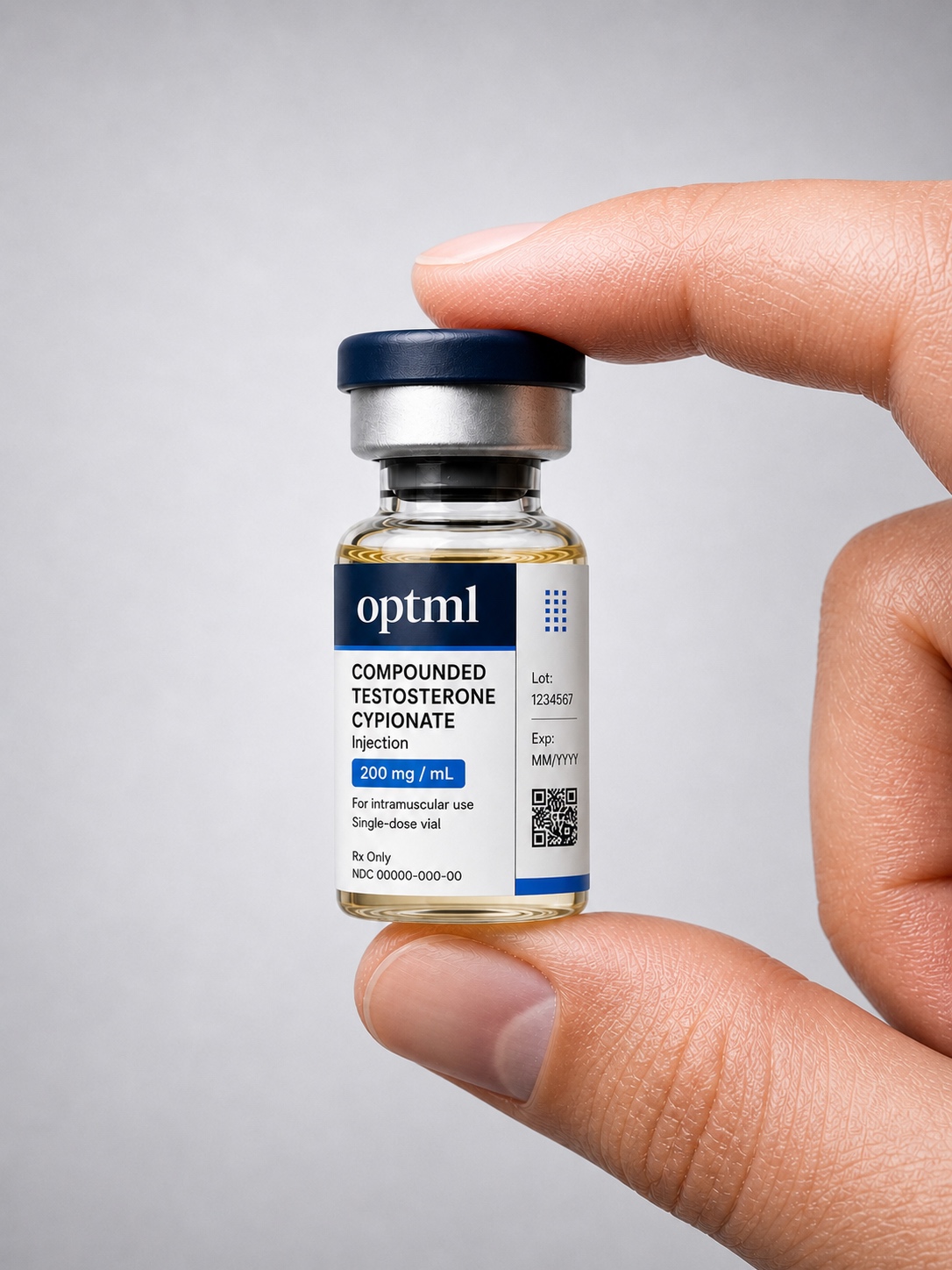
Testosterone cypionate or enanthate, dissolved in oil and injected once or twice weekly. Subcutaneous administration produces stable serum concentrations between doses and is the modern default (McFarland et al., J Endocr Soc 2017); the comparison with intramuscular is set out in SubQ vs IM.
Advantages: fine dose control, a smooth steady state when split across two doses a week, straightforward adjustment when labs come back, and generally the lowest cost. An over- or under-shoot is a two-week correction rather than a season-long one.
Disadvantages: it requires self-injection — the objection that dissolves fastest, since the subcutaneous needles are short and fine and most men stop thinking about it within a month (technique here). Stable levels are not set-and-forget: haematocrit and oestradiol still need monitoring, as on any route.
Cream and gel
Daily transdermal application to the shoulders, upper arms or scrotum. Compounded creams are widely used in men's hormone care.
Advantages: no needles, daily delivery that roughly mimics a natural diurnal pattern, and easy dose adjustment. For a man who is genuinely needle-averse and otherwise stable, this is a legitimate primary route, not a consolation prize.
Disadvantages: skin transfer to partners and children is a real risk requiring actual habits — covering the site, washing hands, not applying before contact. Absorption varies substantially between individuals, and the level you measure depends on how long ago the cream went on. Daily compliance is non-negotiable in a way a twice-weekly injection is not; miss two days and the level is already falling.
Formulation matters. Scrotal skin is thin and highly vascular, and application there produces greater systemic absorption from a smaller quantity than upper-body application (Iyer et al., Andrology 2017). It also raises DHT proportionally more, given the enzyme density of that tissue — useful for some men, unwelcome for others.
Pellets
Crystalline testosterone implanted under the skin every three to six months and released as the pellets dissolve.
Advantages: nothing to do between visits. For someone whose adherence is the limiting factor — and adherence is the most common reason therapy fails — that is a genuine clinical argument, not just convenience.
Disadvantages: the dose cannot be adjusted once the pellets are in. Too high, and you wait for depletion; too low, and you wait or add another route on top. Levels typically peak above physiologic range early and decline through the interval — the pattern most likely to drive oestradiol problems and, in some men, a haematocrit rise (McCullough et al., J Sex Med 2012). Placement is a minor procedure with small risks of extrusion and site infection.
Pellets retain devoted users but have lost ground in modern clinics, and the reason is inflexibility rather than pharmacology: a route that cannot respond to a lab result is hard to titrate toward a target.
Oral testosterone
Newer oral testosterone undecanoate formulations restore concentrations into the normal range in hypogonadal men (Swerdloff et al., J Clin Endocrinol Metab 2020). They are absorbed through the lymphatic route, which is what allows them to bypass the liver toxicity that ended the older oral alkylated androgens.
Advantages: no needles, no skin transfer. Disadvantages: twice-daily dosing, mandatory administration with a fat-containing meal, higher cost, greater peak-to-trough variation than injections, and blood pressure monitoring. A reasonable option for a specific patient, not a general-purpose replacement.
Patches
Adhesive patches applied to the skin. Largely displaced by creams because of application-site skin reactions and less favourable pharmacokinetics. A niche route now.
Side-by-side
| Factor | Injection (SubQ) | Cream | Pellets |
|---|---|---|---|
| Frequency | 2x/week | Daily | Every 3-6 months |
| Dose flexibility | High | High | Low (locked once placed) |
| Pharmacokinetics | Smooth | Daily peak-trough | Initial peak, slow decline |
| Skin transfer concern | None | Real (precautions needed) | None |
| Required procedure | Self-inject | Self-apply | In-office implantation |
| Cost (relative) | Lower | Moderate | Higher |
| Lab adjustment ease | Easy | Easy | Difficult |
How to choose, in order
The decision has a sensible sequence, and most people run it backwards by starting with the convenience question.
First, is fertility a live issue? Every route of exogenous testosterone suppresses the signalling axis that drives sperm production. That is a property of the hormone, not the delivery method, so no route solves it — the conversation is about whether testosterone therapy is the right treatment at all. Fertility on TRT and enclomiphene versus TRT cover the alternatives.
Second, how much titration will this protocol need? A man with a well-characterised baseline and no complicating markers may land close to target first time. A man with high baseline haematocrit or symptomatic oestradiol swings needs a route he can adjust — which means injections or cream. Oestradiol management and haematocrit management most often force that adjustment.
Third, which will you actually do? An imperfect route performed consistently beats an optimal one performed sporadically. Be honest about needles, daily habits, and household contact if there are children.
Fourth, cost and access — only after the first three, because optimising for cost first is how people end up on a route they cannot titrate.
What to expect after choosing
Whichever route is chosen, the first three months are a calibration period rather than a verdict. Levels are checked at a defined point in the dosing interval — with injections, typically at trough; with cream, at a consistent interval after application — because a number without a timing reference cannot be interpreted. Guidelines frame testosterone therapy as diagnosis, titration and ongoing monitoring rather than a single prescription (Endocrine Society clinical practice guideline, J Clin Endocrinol Metab 2018).
Symptom response has its own order and does not match the lab timeline. Libido and mood tend to shift within the first weeks; energy and sleep follow. Body composition changes slowly and depends almost entirely on whether resistance training is happening alongside — see strength training after 40 and a programme like the three-day full-body plan. Expect the first year to involve at least one dose change.
Switching routes later is normal and does not mean the first choice was a mistake. The one route that makes switching awkward is pellets, because you are waiting on depletion rather than making a change — the practical case for not starting there.
The principle: the right route is the one you will do consistently, with the dose flexibility your protocol requires. For most men injections satisfy both, which is why they became the standard — not because the molecule works better that way, but because the protocol can be corrected when the first estimate is wrong.
Bottom line
Delivery route determines the shape of the testosterone curve, how much converts to oestradiol and DHT along the way, and how quickly a wrong dose can be made right. Subcutaneous injections give the flattest curve and the tightest control at the lowest cost, which is why most modern protocols start there. Cream is a legitimate alternative for a needle-averse man on a stable dose who takes skin-transfer precautions seriously. Pellets suit people for whom adherence is the binding constraint, at the cost of the ability to adjust. Choose for titratability first and convenience second, and expect the first year to involve adjustment whichever route you pick. The 60-second assessment is where that conversation starts.
Educational content, not medical advice. Laboratory interpretation and any treatment decision are made by a licensed physician after individual evaluation. Individual results vary.