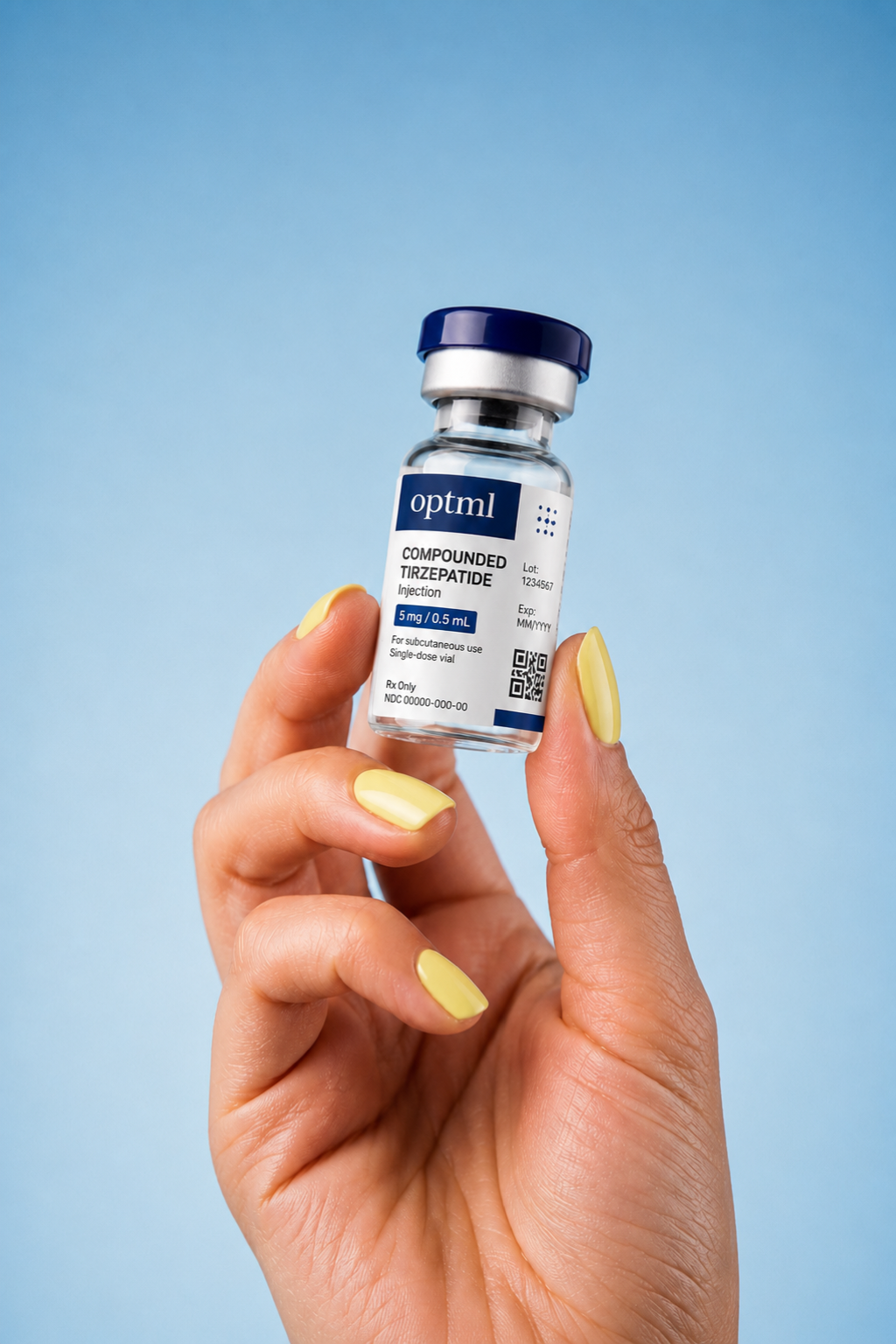
Key takeaways
- The prescription is the easiest part to obtain and the least important part of the outcome.
- Titration is the whole game. Escalating faster than you tolerate is the common self-inflicted error.
- Compounded medications are prepared per patient under prescription and are not FDA-approved.
- Protein and resistance training belong in the plan from week one, not month four.
- A physician can decline, and should, if the history calls for it.
The process, start to finish
Intake covering medical history, current medications, prior GLP-1 experience and your state. Baseline labs, uploaded if recent or ordered during intake if not. Physician review, where a U.S.-licensed physician reads it and determines whether treatment is appropriate for you. If approved, a compounding pharmacy dispenses and ships. Then follow-up, which is where titration decisions get made.
GLP-1 medications are not controlled substances, so the regulatory pathway is simpler than for testosterone. The clinical review is not simpler, and a service that treats it as a formality is doing you no favours.
Who qualifies
A physician weighs your history, current medications, metabolic markers and prior experience with these medications. Certain histories, including a personal or family history of medullary thyroid carcinoma or multiple endocrine neoplasia type 2, and a history of pancreatitis, change the assessment materially.
Being declined is a real outcome, not a technicality. It is also the clearest evidence that the review happened at all.
What compounded actually means
A compounding pharmacy prepares a medication for an individual patient under a physician's prescription. It is a long-established part of American pharmacy practice and it is regulated, but it is not the same thing as a commercially manufactured product. Compounded medications are not FDA-approved.
You should understand that before you start rather than discover it later. A service that does not state it plainly is managing your impression rather than informing you.
Titration is the whole game
GLP-1 therapy starts low and increases in steps. The purpose is to let the gastrointestinal effects settle at each level before adding more, and the schedule is clinical rather than arbitrary.
The most common avoidable problem is pushing the dose up faster than the body is tolerating, usually because progress feels slow. What that tends to produce is worse nausea, missed doses, and an interruption that costs more time than the patience would have.
A protocol that cannot be slowed down when you are struggling is not a protocol, it is a shipping schedule.
The part most services leave out
Weight lost without adequate protein and resistance training is not all fat. That is true of any weight-loss method; it is simply more visible here because the rate of loss can be faster. Four clinical societies have issued joint guidance on nutritional care during GLP-1 treatment, which tells you it is a recognised consideration rather than a marketing angle.
The two levers are protein intake and resistance training, and both are harder on a reduced appetite, which is exactly why they need planning before you start. A service that sends medication and nothing else has handed you half the job.
Side effects, and when they are not normal
Nausea, fullness, constipation and some reflux are common, usually worst in the days after a dose increase, and usually settle. Eating smaller portions more slowly helps more than most people expect.
What is not routine: severe or persistent abdominal pain, particularly pain radiating to the back, repeated vomiting, or signs of dehydration. Those warrant contacting your provider rather than waiting to see.
Semaglutide or tirzepatide?
They are different molecules with different mechanisms. Semaglutide acts on the GLP-1 receptor. Tirzepatide acts on both GIP and GLP-1 receptors. Cost differs, tolerability differs between individuals, and which is appropriate is a physician decision made on your history rather than a preference you select.
There is also a third path people do not always know exists: a microdose protocol aimed at metabolic optimisation rather than weight loss, at sub-clinical doses. A fuller comparison of the two main options is in Semaglutide vs. Tirzepatide.
How it works at OPTML, specifically
Every line below is what is on the product page, not a general description of the industry. You are not charged until a physician approves.
Who reviews it. A U.S.-licensed physician in the OPTML provider network. Physician consultation and ongoing care are included rather than billed separately, which matters most later, when a dose needs changing.
Where the labs happen. If you do not have recent bloodwork, the order is released after review and drawn at a Quest, Labcorp or BioReference patient service center. There are more than 3,800 in the network. Hawaii and North Dakota have no patient service center from either Quest or Labcorp, so labs there are drawn locally and uploaded instead. Treatment is available in all 50 states.
What ships. Compounded semaglutide or tirzepatide, prepared for you individually at a 503A compounding pharmacy and pre-mixed and ready to inject, with no powder to reconstitute and no mixing step. Free discreet shipping. Cancel anytime. HSA and FSA eligible.
What comes with it. Physician consultation and ongoing care, plus the OPTML 30, a 30-day starter covering mindset, a customizable meal plan and a gym-or-dumbbell workout. On a weight-loss medication you also get the GLP-1 Muscle Loss Protocol, an educational guide to preserving muscle during medically supervised weight loss, and the GLP-1 field guides: a side-effect playbook and what to expect week by week. That is the part of this that most services do not send at all.
Where to start. Semaglutide, tirzepatide, or the microdose protocol if the goal is metabolic rather than weight loss. Find my protocol takes four questions.
What it costs
With OPTML, compounded semaglutide is $249 a month and compounded tirzepatide is $349 a month. Baseline bloodwork is separate, roughly $80 if you do not have recent labs, ordered during intake rather than folded into the monthly price.
Insurance generally does not cover compounded medication, so this is usually a cash-pay decision. When comparing services, compare what is included: whether labs are part of it, whether follow-up with a physician is included or billed, and whether anyone is helping with the protein and training side at all.
Common questions
Can you get a GLP-1 prescription online?
Yes. You complete a medical intake, a U.S.-licensed physician reviews your history and determines whether treatment is appropriate, and if approved a compounding pharmacy dispenses and ships it. GLP-1 medications are not controlled substances, so the telehealth pathway is straightforward.
Do I need bloodwork for a GLP-1?
A physician will want a baseline. Metabolic markers, including fasting glucose and A1c, thyroid, and kidney and liver function, both to inform the decision and to give you something to measure against later. If you have recent labs you can upload them.
What does compounded mean?
A compounded medication is prepared by a licensed compounding pharmacy for an individual patient under a physician prescription, rather than manufactured as a commercial product. Compounded medications are not FDA-approved. That is a meaningful distinction and worth understanding before you start.
How fast does the dose increase?
Slowly, and slower than most people want. Titration exists to let the gastrointestinal side effects settle at each step. The most common self-inflicted problem on a GLP-1 is escalating faster than the body is tolerating.
Will I lose muscle on a GLP-1?
Weight lost without adequate protein and resistance training is not all fat, and that applies to any method of losing weight, not only this one. Four clinical societies have issued joint guidance on nutritional care during GLP-1 treatment for this reason. Protein intake and resistance training are the two levers, and they are worth planning before you start rather than after.
What if the side effects are severe?
Nausea that settles over a few days after a dose increase is expected. Severe or persistent abdominal pain, repeated vomiting, or signs of dehydration are not, and are reasons to contact your provider rather than wait it out.
Compounded medications are not FDA-approved. Nothing here is prescribed on the strength of an article or a quiz. You complete an intake form, a U.S.-licensed physician reviews your history and your labs, and they determine whether treatment is appropriate for you. They may decide it is not.