Key takeaways
- Dopamine in the mesolimbic circuit — ventral tegmental area to nucleus accumbens — encodes wanting rather than pleasure: the anticipatory pull a cue creates, not the enjoyment of the thing itself.
- GLP-1 receptors are expressed on those VTA dopamine neurons, and activating them makes the neurons less likely to fire, reducing dopamine release in response to food cues.
- Dopamine is usually called the pleasure molecule — close enough for conversation, wrong enough to mislead anyone trying to understand their own behaviour.
- The medications are long-acting versions of that signal, and its receptors are not confined to the pancreas and gut.
- Functional imaging has now been done in people on GLP-1 receptor agonist therapy.
Patients on GLP-1 therapy describe the change in almost identical language, and it is rarely about hunger. The head is quieter. The bakery on the walk to work stops registering as a decision. The 9 PM pull toward the kitchen does not arrive. That is not a smaller stomach. It is reduced wanting — and wanting has a specific neurochemistry, running through a circuit that GLP-1 receptors sit directly on.
Wanting and liking are not the same system
Dopamine is usually called the pleasure molecule — close enough for conversation, wrong enough to mislead anyone trying to understand their own behaviour. It is better described as the molecule of wanting: the motivational signal driving seeking and goal-directed action. The pleasure itself, the liking of food once it is in your mouth, runs on different chemistry including opioid signalling, and the two can be pulled apart experimentally (Berridge et al., Curr Opin Pharmacol 2009).
That separation is the reason this topic matters. It is entirely possible to want something intensely and enjoy it very little — in everyday language, compulsion — and that is what most people are describing when they say they cannot stop eating something they do not particularly like.
What dopamine encodes is the gap between the reward you expected and the reward you got. Anticipation produces the spike — the smell, the sight, the time of day — and consumption returns the signal toward baseline if delivery matched prediction. Over time, cues that reliably precede a large reward take on the signal themselves. This is why the cue, not the hunger, usually starts the sequence.
The circuit underneath
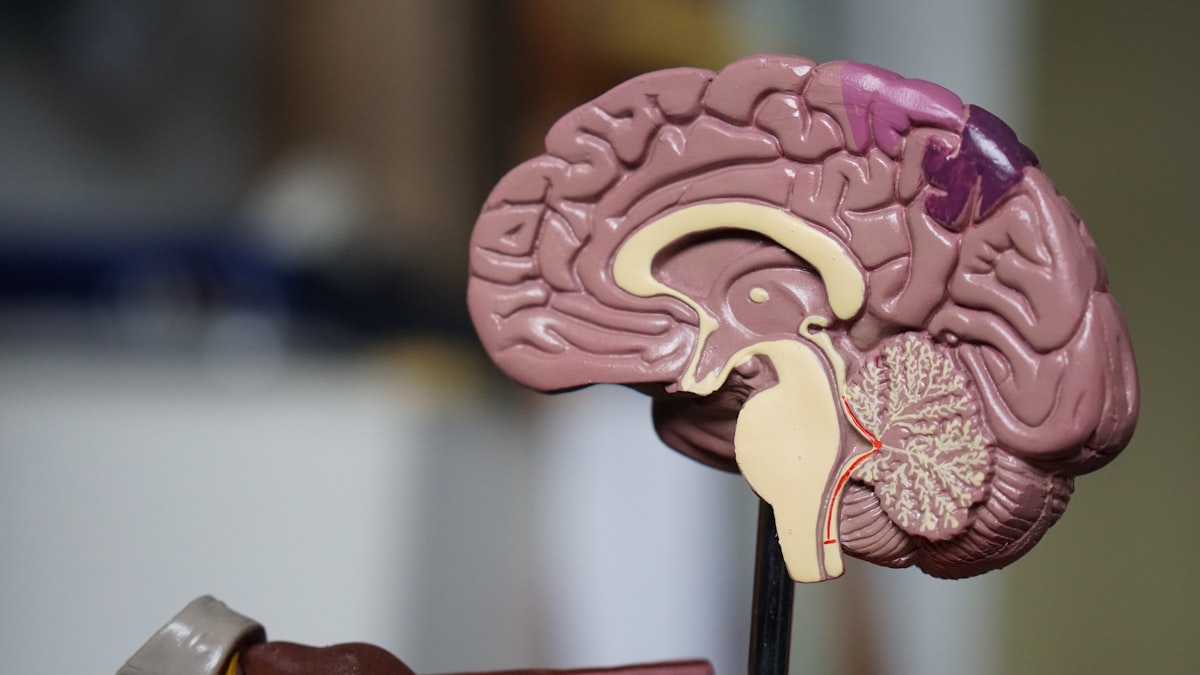
The mesolimbic pathway is the anatomy of all of this.
- Ventral tegmental area (VTA) — the midbrain dopamine cell bodies, where the signal originates.
- Nucleus accumbens — the main projection target, where wanting becomes approach behaviour.
- Prefrontal cortex — top-down control; the part that works worst when you are tired.
- Amygdala — attaches emotional weight to cues, which is how a place or a mood becomes a trigger.
The circuit evolved to make animals pursue things that were scarce and calorically valuable. Nothing in its design anticipated an environment where the most reward-dense options are engineered, cheap and permanently available. Hyperpalatable food produces a larger dopamine response than anything in the ancestral diet, and the circuit does what it was built to do: it learns the cue and raises the wanting attached to it. Understood that way, food noise stops being a personality trait — it is the subjective read-out of a learned cue-response loop working exactly as designed in an environment it was never calibrated for.
Where the medication acts
GLP-1 is a hormone the gut already releases when you eat. The medications are long-acting versions of that signal, and its receptors are not confined to the pancreas and gut. They are expressed on VTA dopamine neurons themselves (Mietlicki-Baase et al., Am J Physiol Endocrinol Metab 2013), which means the reward circuit has a direct receiving line for a satiety signal.
Activating those receptors hyperpolarises the neuron — makes it less likely to fire — and reduces dopamine release into the nucleus accumbens in response to cues. Animal work with direct neural recording maps this, and the wider literature on central GLP-1 signalling in food intake and reward converges on the same place: a central effect, not only a gut one (GLP-1 receptor agonists at the crossroads of obesity and addiction, Pharmacol Biochem Behav 2026).
Two features matter. The action is on cue-driven anticipation rather than consumption pleasure — reward function is not switched off, and people on therapy still enjoy food, music, sex and achievement. And it runs alongside, not instead of, the peripheral effects of slower gastric emptying and glucose-dependent insulin release. What people notice is the sum of a gut effect and a brain effect, and the brain effect is why the quiet persists between meals rather than only after them.
What human imaging shows
Functional imaging has now been done in people on GLP-1 receptor agonist therapy. Shown images of hyperpalatable food, the consistent pattern is reduced activation in the nucleus accumbens, reduced activation in the orbitofrontal cortex — the region involved in assigning value to a food — and increased prefrontal activity associated with inhibitory control (van Bloemendaal et al., Diabetes 2014).
The imaging matches the report: the cue is still perceived, but valued lower and controlled more easily. That is a different experience from suppressed appetite, which is why patients describe a change in thinking rather than a change in stomach.
What to expect, and in what order
The sequence is worth knowing in advance, because misreading it is how people conclude the medication is not working. The gut effects arrive first and are obvious: meals end earlier, food sits longer. The reward effect is quieter and easy to miss, because it announces itself as an absence — nothing happens at 9 PM, and you drive past somewhere you would normally stop. Most people notice it retrospectively, as a week in which food occupied less mental space than usual.
Three things generally do not change. Appetite for food you genuinely enjoy in a planned setting stays largely intact, reward from non-food sources is preserved, and the learned habits themselves do not disappear — the pull weakens, but a twenty-year routine is still a routine. Therapy creates a window in which new behaviour is unusually easy to install; the window is the opportunity, not the outcome. It is also why protein and training matter most during it, since reduced wanting reduces intake indiscriminately and lean tissue is what has to be defended (muscle preservation playbook, the protect-your-muscle programme).
Why the effect does not stop at food
If the mechanism is dampened mesolimbic signalling rather than anything food-specific, other reward-driven behaviours should shift too. That prediction has largely held.
- Alcohol — the best-documented case, with both preclinical work and human data pointing the same way (Jensen et al., Alcohol Clin Exp Res 2025; Jerlhag, Biol Psychiatry 2026). Covered in full in GLP-1 and alcohol use.
- Nicotine — preliminary signals only, and not yet a basis for anything clinical.
- Compulsive non-substance behaviours — shopping, gambling, scrolling. Reports are consistent with the mechanism but anecdotal, and anecdote is where this class of claim usually goes wrong.
The honest position: the neuroscience is coherent, the food and alcohol evidence is strongest, and everything past that is plausible and unproven.
The limits worth stating
Dampening a reward circuit is not free of trade-offs. The same mechanism that quiets food noise can flatten motivation more broadly in some people, and loss of interest in eating altogether, food aversion or a general dulling of drive are worth reporting rather than tolerating.
The effect is also pharmacological, which means it is present while the drug is. Wanting returns when the signal is withdrawn; nothing here permanently rewrites the cue-response loop. And dopamine signalling in this circuit is not owned by any one intervention — sleep debt, chronic stress and low testosterone all move the same system, which is why testosterone and dopamine reads as a near-parallel story. A reward system undermined by four hours of sleep is not a pharmacology problem.
The clinical pearl: the quieter head corresponds to measurable changes in reward-circuit activity. It is pharmacology, not a willpower upgrade — which cuts both ways. Credit the medication for the reduced pull, and credit yourself for what you build while it is lower.
Bottom line
GLP-1 receptors sit on the dopamine neurons of the ventral tegmental area, and activating them reduces dopamine release into the nucleus accumbens in response to cues. Human imaging shows the matching pattern: less reward-circuit activation to food images, more prefrontal control. That explains the reported experience better than appetite suppression does — the food is still enjoyable and the cue is still visible, but the wanting that converted cue into action is weaker. It also explains why the effect extends to alcohol, why it lasts only as long as the medication does, and why the useful question is not how quiet the head gets but what gets built while it is quiet. Whether this class of medication is appropriate is a clinical decision made after evaluation — the 60-second assessment is where that starts.
Educational content, not medical advice. Laboratory interpretation and any treatment decision are made by a licensed physician after individual evaluation. Individual results vary.