Key takeaways
- Women produce testosterone naturally, about 10x less than men, but it's a critical hormone for them too.
- Testosterone in women is produced by the ovaries and the adrenal glands, at roughly a tenth to a twentieth of male output.
- Female testosterone peaks in the mid-twenties and declines gradually, reaching roughly half its peak by around age 50.
- Every prescription is therefore off-label use of a male product at a reduced dose, or a compounded preparation.
- Dose, form and frequency are set by the prescribing physician against your labs and your response.
Testosterone is routinely described as the male hormone, which is a useful shorthand and a poor description of the biology. Women produce it too, they produce more of it than they produce oestradiol by mass, and it declines steadily from the mid-twenties. Whether that decline should be treated is a genuinely contested question — and the honest answer is narrower than the enthusiasts claim and wider than most primary care offers.
What testosterone does in women
Testosterone in women is produced by the ovaries and the adrenal glands, at roughly a tenth to a twentieth of male output. It is not a vestigial hormone. It is a precursor to oestradiol, and it acts on androgen receptors distributed through the brain, bone, muscle, skin and vascular tissue.
Its best-characterised role is in sexual desire and arousal. Beyond that, women with clinically low androgen levels frequently describe low energy, flat mood and reduced motivation — though, as below, the evidence that supplementing testosterone reliably fixes those particular complaints is much weaker than the evidence for desire.
When and why it falls
Female testosterone peaks in the mid-twenties and declines gradually, reaching roughly half its peak by around age 50. Unlike oestradiol, it does not fall off a cliff at menopause — the decline is a slow slope that begins decades earlier, which is part of why it goes unnoticed and untested.
Some things drop it abruptly. Surgical removal of the ovaries causes an immediate and substantial fall. Combined oral contraceptives raise SHBG, which lowers free testosterone. Chronic illness, sustained stress and long-term corticosteroids all suppress production.
What the evidence actually supports
This is where honesty matters more than enthusiasm, and where the authoritative source is the Global Consensus Position Statement on the Use of Testosterone Therapy for Women (Davis et al., J Clin Endocrinol Metab 2019), produced jointly by the major endocrine and menopause societies, alongside the accompanying systematic review and meta-analysis (Islam et al., Lancet Diabetes Endocrinol 2019).
What it endorses. The single evidence-based indication is hypoactive sexual desire disorder in postmenopausal women — distressing low desire, after other contributors have been addressed. For that indication the randomised evidence is consistent: improvements in desire, arousal, orgasm and sexual satisfaction, and a reduction in associated distress.
What it does not endorse. The same review concluded there was insufficient evidence to recommend testosterone for cognition, mood, bone density, general wellbeing or musculoskeletal outcomes in women. That is not the same as saying it does nothing for those things — it means the trials have not established it. Any source presenting muscle, body composition or energy as proven benefits of testosterone in women is ahead of the evidence.
Being straight about that is worth more than a longer list. It also sets a realistic expectation, which is the difference between a therapy that feels like it worked and one that disappoints.
The awkward part: no approved product
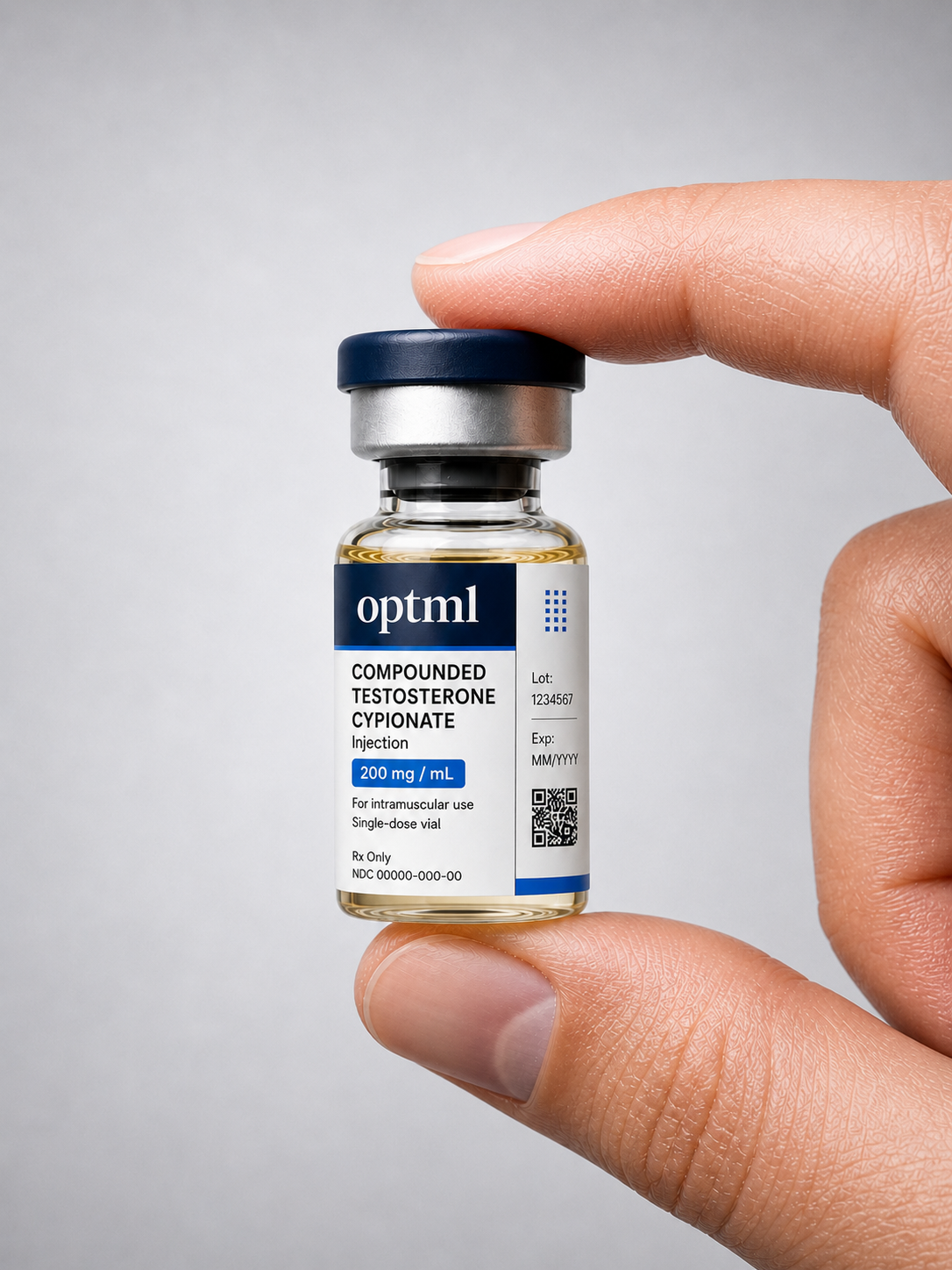
There is currently no testosterone product approved for women in the United States. Every prescription is therefore off-label use of a male product at a reduced dose, or a compounded preparation.
That has two practical consequences. It is why so few primary care clinicians offer it — off-label prescribing without a clear licensed product is a barrier. And it means dose accuracy depends heavily on the preparation and the prescriber, because male products are not packaged for a tenth of a male dose.
Compounded preparations are not FDA-approved or evaluated by the FDA for safety, effectiveness, or quality. Individual results vary.
Dosing, and why the number is so small
| Form | How it behaves | Notes |
|---|---|---|
| Transdermal cream | Daily, adjustable | Most common; the easiest to titrate up or down |
| Sublingual troches | Daily, steady | More even delivery through the day |
| Pellets (subcutaneous) | Months at a time | Long-acting; cannot be adjusted or withdrawn once placed — the main reason to be cautious with them |
Dose, form and frequency are set by the prescribing physician against your labs and your response. Nothing here is a prescribing protocol.
These are a tenth to a twentieth of typical male doses. The stated goal in the consensus guidance is explicit and worth repeating: restore concentrations to the premenopausal physiological range, and not above it. Supraphysiological dosing is where the side-effect profile changes from "uncommon and reversible" to "sometimes permanent."
The pellet row deserves a flag. Pellets are convenient and they are also irreversible for their duration — if the dose turns out to be too high, there is no way to reduce it for three to four months. Guidance has been notably cautious about pellet dosing in women for exactly this reason.
Side effects, and which ones matter
At physiological doses, side effects are uncommon. At supraphysiological doses:
- Acne and oily skin — common, dose-related, reversible.
- Increased facial or body hair — slow to develop, usually reversible if caught early.
- Scalp hair thinning in genetically susceptible women.
- Voice deepening — uncommon, and generally not reversible.
- Clitoral enlargement — uncommon, and may not fully reverse.
Note the split. The first three are nuisances that resolve on dose reduction. The last two are the reason dosing discipline and monitoring are not optional. Long-term cardiovascular and breast safety data for testosterone in women are limited, which the consensus statement states plainly and which argues for physiological dosing and periodic review rather than indefinite unmonitored use.
Testing, and why it is harder than it looks
Typical female reference ranges run around 8-60 ng/dL total testosterone and 0.3-1.0 ng/dL free, though ranges vary by laboratory.
The complication is assay quality. Many standard immunoassays were designed for male concentrations and perform poorly at the much lower levels found in women — a result near the bottom of the female range may not be reliable. Liquid chromatography-mass spectrometry is the accurate method at these concentrations. Calculated free testosterone using SHBG is generally more informative than a directly measured free value.
The consensus guidance is also clear that a blood level should not be used to diagnose anything on its own. There is no testosterone concentration that defines deficiency in women. Testing is used to exclude high baseline levels before starting and to confirm the physiological range is not being exceeded during treatment — monitoring, not diagnosis.
The clinical pearl: Testosterone in women is simultaneously under-offered and over-promised. Under-offered, because postmenopausal women with distressing low desire have a genuine evidence-based option most are never told about. Over-promised, because it is widely marketed for energy, mood, cognition and body composition, none of which the evidence currently supports.
Bottom line
Testosterone is a normal part of female physiology and it declines from the mid-twenties. For postmenopausal women with hypoactive sexual desire disorder, testosterone therapy has good randomised evidence and is endorsed by international consensus. For everything else — energy, mood, cognition, bone, muscle — the evidence is currently insufficient, and claims to the contrary run ahead of the data. There is no product approved for women in the US, so this is off-label or compounded prescribing. Dose to the premenopausal physiological range and no higher, prefer preparations that can be adjusted over ones that cannot, use a mass-spectrometry assay, and treat blood levels as monitoring rather than diagnosis.
Educational content, not medical advice. Compounded preparations are not FDA-approved or evaluated by the FDA for safety, effectiveness, or quality. Individual results vary. Diagnosis, prescribing and monitoring are decisions for a licensed physician after individual evaluation.